Resources

Search below for resources covering the intersection of climate engagement, social science and data analytics.

RESULTS

Reparative Justice in the U.S. Territories: Reckoning with America’s Colonial Climate Crisis

Susan K. Serrano, University of Hawai'i Richardson School of Law & Ian Tapu
Research & Articles
11-15-2022

It offers a developing conceptual framework that draws upon “climate reparations” insights, as well as concepts of reparative justice and human rights notions of self-determination. It then employs this method of inquiry to briefly assess the recently introduced Insular Area Climate Change Act, which seeks to reduce climate crisis impacts on U.S. territories and freely associated states. It concludes that, while the Act is a significant step forward, climate resiliency for the U.S. territories requires an expansive and particularized reparative effort that advances the territories’ self-determination and prioritizes the peoples’ on-the-ground needs and approaches to decolonization.

IRA: Our Analysis of the Inflation Reduction Act

Sylvia Chi, Just Solutions Collective
Research & Articles
09-15-2022

The Inflation Reduction Act (IRA) will invest $40 billion total, including $27 billion in direct spending, towards environmental justice communities and low-income residents—despite supporters claiming that the amount is $60 billion. Just Solutions Collective performed its own section-by-section analysis of the IRA’s text, adding up appropriations and other tailored spending to produce its own calculation. In total, the IRA includes $228 billion in appropriations and an additional $324 billion in tax expenditures. Direct appropriations in the IRA for environment, climate, and energy total $145 billion. This is dwarfed by the $270 billion provided in energy-related tax expenditures, through a variety of tax credits intended to incentivize primarily the private sector to invest in different aspects of the alternative energy economy: from mining companies extracting lithium to factories manufacturing inverters to refineries making biomass-based jet fuel to utilities installing solar arrays.

A Decade Of Successes Against Fossil Fuel Export Projects In Cascadia

Emily Moore, Fossil Fuels Transition. Sightline Institute
Research & Articles
05-31-2022

73% of initially planned oil, gas, and coal export projects in the region have been cancelled since 2012. Fossil fuel executives from dozens of companies once seemed to be salivating over the idea of exporting massive quantities of gas, oil, and coal from the Cascadia coast—but local communities, Tribes, environmentalists, and local governments rejected calls to turn Cascadia into a fossil fuel export terminal. They protested projects’ abrogation of Indigenous sovereignty, the risk of oil spills and damage to sensitive ecosystems, the pollution spewing from coal trains, the climate harms of extracting, transporting, and burning hydrocarbons, and the safety hazards of transporting flammable fuels through populated areas—and for the most part, they’ve won. Since 2012, fossil fuel interests have schemed more than 50 large projects to export coal, oil, gas, or their derivatives from Cascadia’s coast in British Columbia, Oregon, and Washington, and today, 40 of those—a whopping 73%—have been canceled by project backers who faced local opposition, see-sawing energy prices, and regulatory hurdles.

This resource showcases entry points for those interested in working with Indigenous communities or strengthening existing work. The goal of this project was to inform and support non-Indigenous conservation groups and conservation and environmental funders’ staff and boards working with Indigenous communities. Recognizing that when we need to learn new information, we often seek out others we know who have undergone similar learning, this guide attempts to recount different journeys taken by organizations and staff. There are two general paths: the journeys of non-Indigenous organizations and funders to work with Indigenous communities or governments and the journeys of Indigenous people, non-profits, and government employees to work with non-Indigenous environmental and conversation organizations and/or funders. Each participant reviewed their organization’s draft for accuracy and clarity, with many providing content.

Applying an Alaska Native Lens to Climate Sovereignty, Economic Justice, and Healing

Ruth Miller, Meda Dewitt, and Margi Dashevksy. Non-Profit Quarterly
Research & Articles
11-15-2021

The Alaska Just Transition Collective is working to build a solidarity economy that will help Alaska move towards a just transition that cultivates grassroots processes incorporating indigenous sovereignty and stories from the land. Indigenous economic frameworks for redistributing wealth and resources must inform an approach to economic recovery. Traditional indigenous economic frameworkers ensure the health and well-being of the community and center the concept of reciprocity. 

Why Intersectional Stories Are Key to Helping the Communities We Serve

Annie Neimand, Natalie Asorey, Ann Christiano, and Zakyree Wallace. University of Florida College of Journalism and Communications. Stanford Social Innovation Review
Tips & How-Tos
09-28-2021

Many people communicating for social change are exploring how to tell diverse and inclusive stories that center marginalized communities while building understanding about how inequality persists. Intersectionality is an important tool to help us tell great stories that help us understand systemic issues. Five guiding principles to telling intersectional stories: Show, don’t tell; Provide historical context; Uplift the voices of marginalized people; Tell whole stories; and, Radically reimagine the world.


GenGND Conversation with Kaniela Ing

Generation Green New Deal podcast
Research & Articles
06-23-2021

Hawaiian organizer and strategist Kaniela Ing describes his theory of politics in this podcast episode. Kaniela is the Climate Justice Director with People’s Action, former state legislator, and former candidate for U.S. Congress. He argues that building power only happens through organizing, and insider lobbying only works to “wield” power, even though traditional advocacy organizations often view power only through lobbying. Kaniela says that growing up in a working-class, conservative household showed him that progressive organizers need to be understanding and empathetic and can win working-class Republicans over to progressive causes. He also describes (harmful) capitalist, colonial influences on Hawaiian local economies.             

Research & Articles
04-01-2021

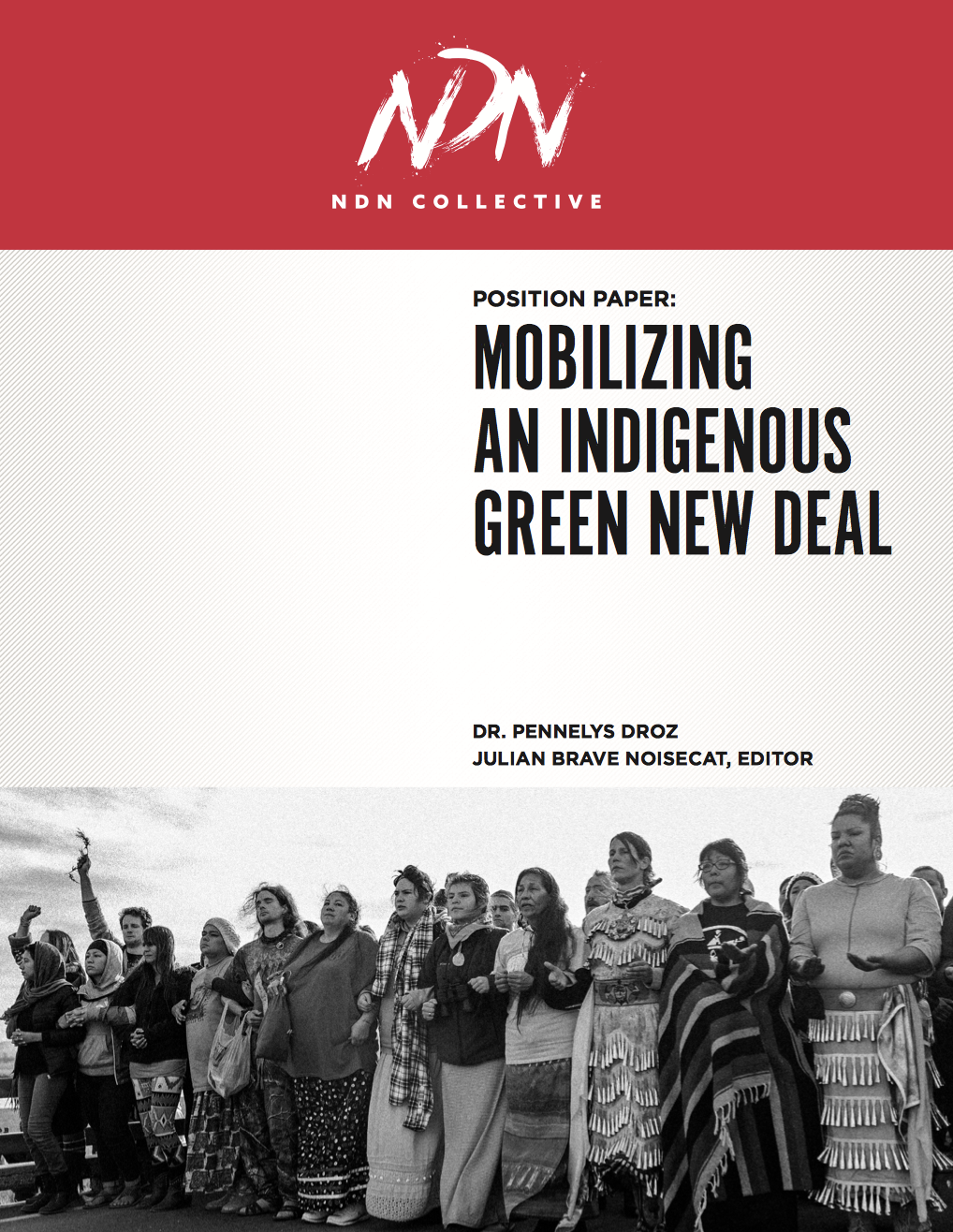
The Red Deal is a powerful guide to Indigenous liberation and the fight to save the planet. Only mass movements can do what the moment demands. Politicians may or may not follow—it is up to them—but we will design, build, and lead this movement with or without them. The Red Deal is a call for action beyond the scope of the US colonial state. It’s a program for Indigenous liberation, life, and land—an affirmation that colonialism and capitalism must be overturned for this planet to be habitable for human and other-than human relatives to live dignified lives. The Red Deal is not a response to the Green New Deal, or a “bargain” with the elite and powerful. It’s a deal with the humble people of the earth; a pact that we shall strive for peace and justice and a declaration that movements for justice must come from below and to the left.

Research & Articles
03-31-2021

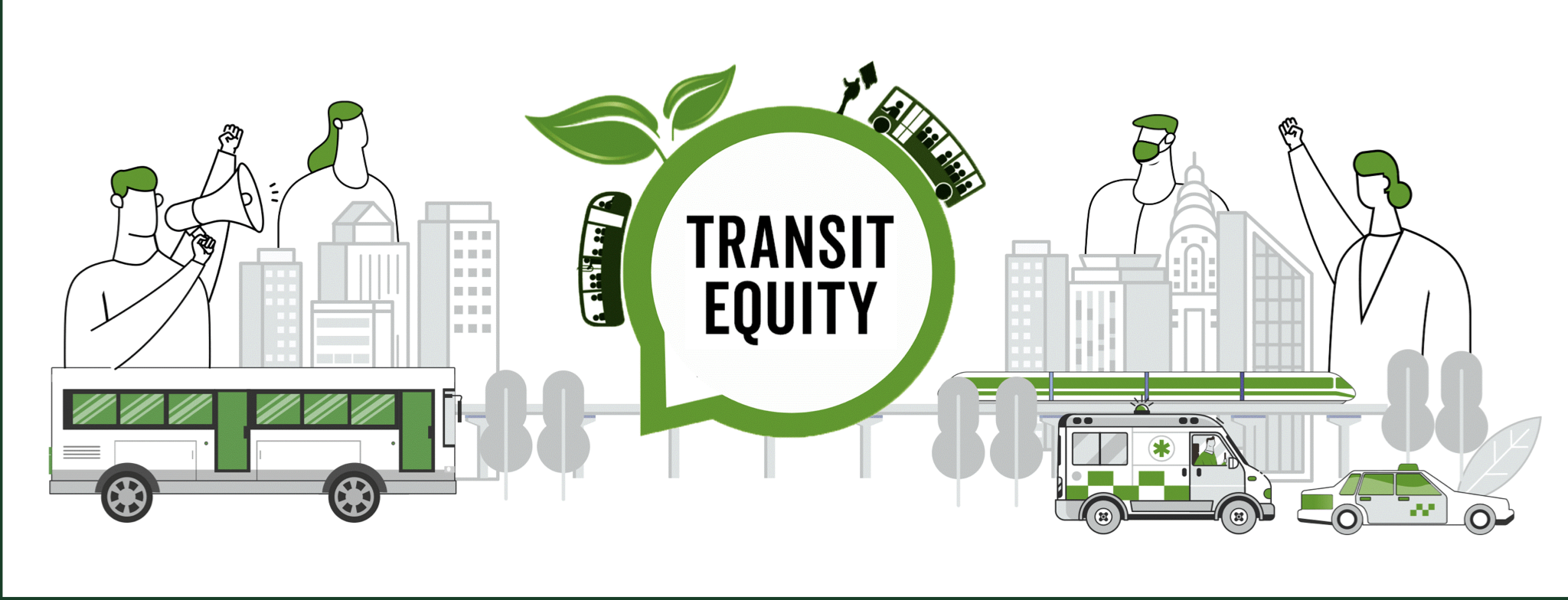
Increasing accessibility, affordability, and reliability of public transit is imperative for BIPOC, low-income people, those living in rural areas, seniors, youth, and people with disabilities. COVID-19 exacerbated transportation inaccessibility because of limited routes and slashed service times. It also posed significant threats to transit workers who were not given adequate protection. Transit agencies must have safeguards in place to combat the negative effects of future pandemics as well as climate change. Such policies include better sick and family leave policies for transit drivers and electrification of the transportation sector to meet climate goals.             
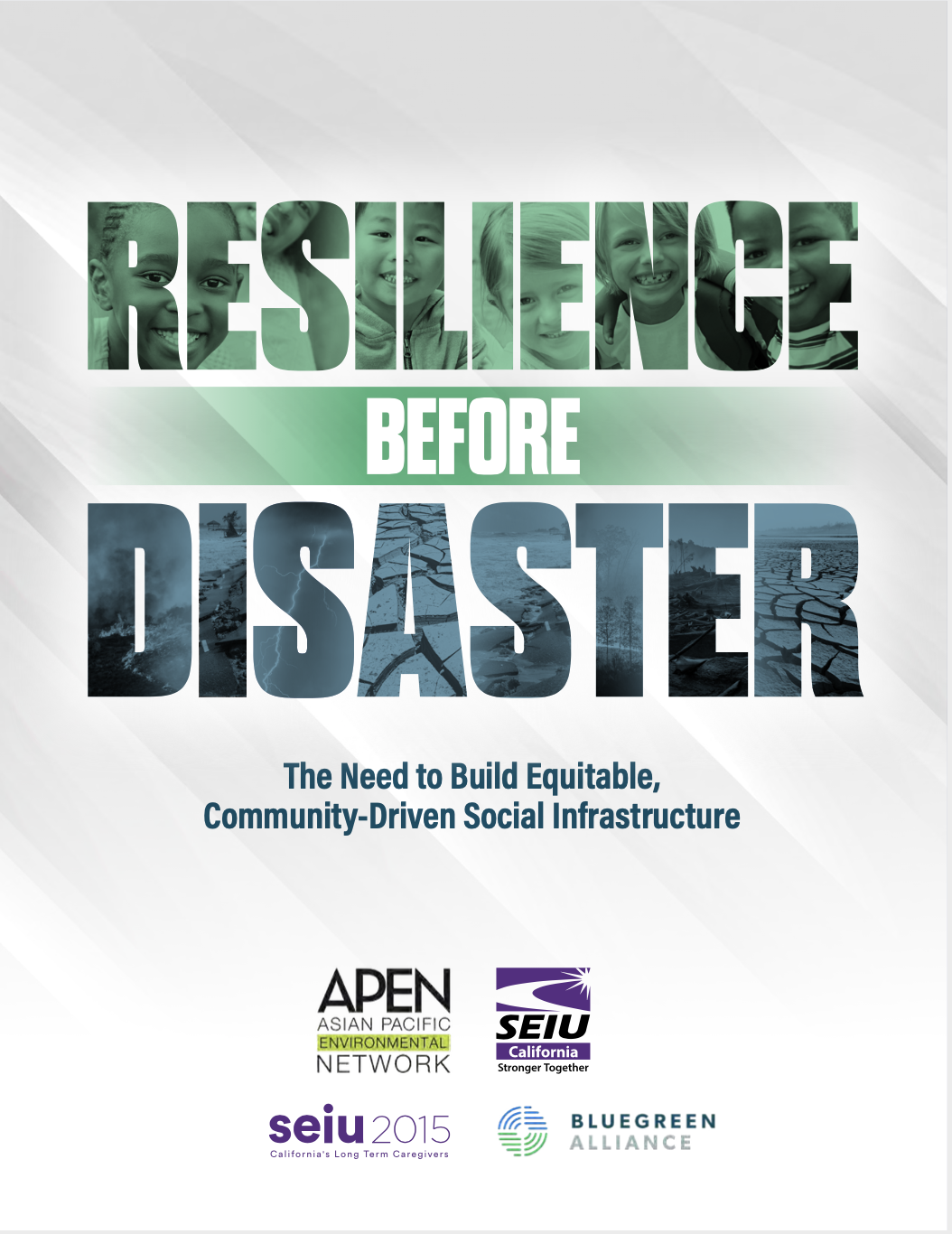
Resilience Before Disaster: The Need to Build Equitable, Community-Driven Social Infrastructure

Zach Lou, Amee Raval, Marguerite Young & Sam Appel for Asian Pacific Environmental Network (APEN), SEIU California, SEIU 2015 & BlueGreen Alliance
Research & Articles
12-21-2020

California and the US are increasingly beset by climate-fueled disasters like wildfires, extreme heat, and power blackouts. These events put additional stress on frayed hard and social infrastructure systems, and disproportionately impact working-class communities of color. To adapt to these changes, society must update our notion of disaster response to increase resilience in these systems before disasters strike. This report offers two models for this response: 1) building and normalizing resilience hubs where community members gather and organize both in good times and bad, and 2) increasing in-home resilience by recognizing homecare workers as effective agents for assisting vulnerable populations and bridging authorities and the frontlines. The report goes on to recommend specific ways to set up resilience hubs, train care workers, and develop forward-thinking emergency response plans to avert human disasters after natural disasters.