Resources
Search below for resources covering the intersection of climate engagement, social science and data analytics.
RESULTS
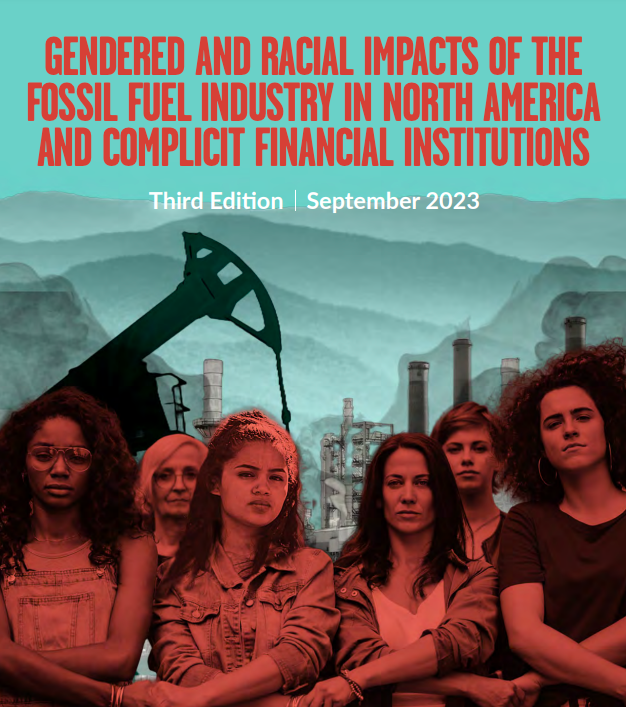
Gendered and Racial Impacts of the Fossil Fuel Industry in North America and Complicit Financial Institutions
This report finds an indisputable connection between the fossil fuel industry’s practices and negative impacts to African American/Black/ African Diaspora, Indigenous, Latina/Chicana, and low-income women’s health, safety, and human rights in the U.S. and parts of Canada. Specifically, fossil fuel-derived air, water, and soil pollution impact women’s fertility, mental health, and daily work and responsibilities. The negative effects from fossil fuel activity—including extraction, storage and transportation of coal, oil, and gas often in the form of liquefied natural gas (LNG)—stem from direct pollution of communities by fossil fuel companies’ contributions to industrial carbon dioxide and methane. The climate crisis does not and will not affect everyone equally, as factors such as gender, race, and socio-economic status make certain communities significantly more vulnerable to the increasing threats of climate change. Global inequalities, rooted in structural patriarchy, colonialism, white supremacy, and capitalism, continue to place people of the global majority, and specifically women, at risk.
Environmental Polling Roundup - August 25th, 2023
This post includes climate and environment headlines, data points, and key takeaways from recent public polls - including new polling on conservative groups' environmental ideas, extreme weather, messaging about climate justice, and western voters' conservation preferences.
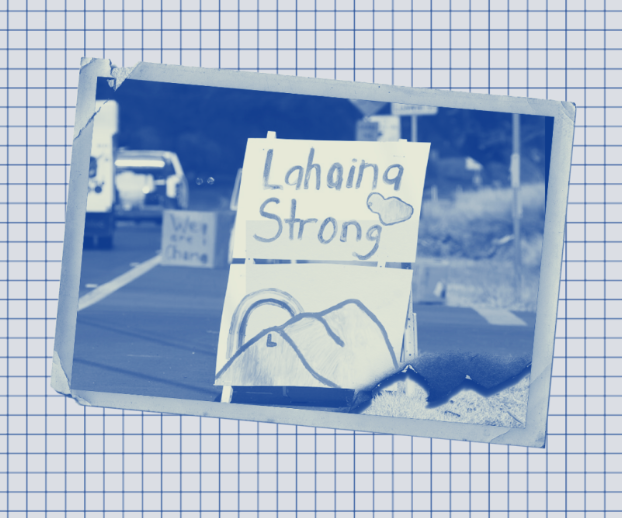
How Americans Are Reacting To The Maui Wildfires
Americans are making the connection between natural disasters and climate change and support urgent action on environmental issues. 37% of Americans believed that the recent wildfires in Maui are primarily the result of climate change, while a similar share (36%) said these events just happen from time to time, and 21% said they weren’t sure. But under those topline numbers, there’s a big partisan divide. According to the poll, 63% of voters who supported President Biden in 2020 think that the recent wildfires in Maui are primarily the result of climate change, while the same share of Trump voters just think these things happen from time to time. Most Americans agree that the weather across the U.S. has gotten weirder — and in some cases, deadlier — over the past few years. According to an Ipsos poll conducted in April, two-thirds (67%) of respondents agreed that unusual weather for the season has gotten more frequent in their area than compared to 10 years ago, and a solid majority (60%) thought the weather has also become more intense.
Poll: What the data says about Americans’ views of climate change
The majority of Americans say that climate change is affecting their local community. Most want the government to encourage clean energy but not fossil fuels. 67% of Americans agree that large businesses and corporations are doing too little to help reduce the effects of global climate change. 66% of Americans say that the federal government should encourage the production of wind and solar power. 61% of Americans agree that climate change is having at least “some” impact on their local community. 58% of Americans agree that their state elected officials are doing too little to help reduce the effects of global climate change.
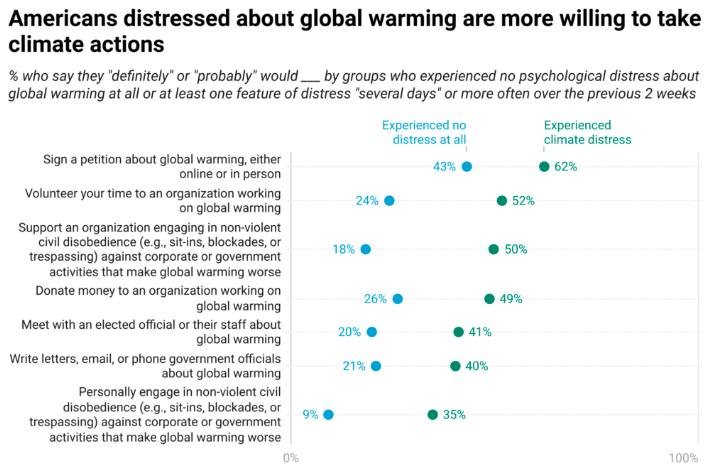
Is distress about climate change associated with climate action?
Americans who experience climate distress are more likely to take personal action on climate change. Americans who had experienced at least one feature of climate distress were much more likely than those who had not to say they had taken different forms of climate action. This includes having signed a petition about global warming (46% vs. 10%, respectively), or having volunteered at an organization working on global warming (19% vs. 2%). Americans who experienced at least one feature of climate distress were more likely than those who had not to say they would meet with an elected official or their staff about global warming (41% vs. 20%, respectively), write letters, email, or phone government officials about global warming (40% vs. 21%), or personally engage in non-violent civil disobedience (e.g., sit-ins, blockades, or trespassing) against corporate or government activities that make global warming worse (35% vs. 9%).
Why the climate movement doesn’t talk about polar bears anymore
Global warming moved from the North Pole to your backyard — and so did its symbols. Starting about two decades ago, National Geographic and the like began churning out images of lonely, hungry bears adrift on melting ice floes, painting them as the hapless victims of climate change. But today, that symbol has largely fallen out of fashion. The advocacy group ClimateXChange even says the focus on the polar bear has done a “disservice” to the goals of the movement, and a handbook for public engagement for members of the Intergovernmental Panel on Climate Change, the world’s leading group of climate experts convened by the United Nations, says the image prompts “cynicism and fatigue.” As climate change began to have visible effects in richer countries, the movement to new imagery happened naturally.

July Was Hot As Hell. Do Voters Care?
There is more climate denial in the US than in any other country. In this podcast episode, Anthony Leiserowitz from the Yale Program on Climate Change Communication joins the FiveThirtyEight podcast. Profitable fossil fuel resources in the US (and a few other English-speaking countries) are a primary cause of organized climate denial in the US. Now in America, a record high 74% believe that climate change is happening, and 61% believe climate change is human-caused. Beliefs about climate are very polarized in US: Republicans are far less likely to say that climate and extreme weather are affecting them. However, there are instances where Republicans and conservatives can support clean energy policies.
Americans widely believe that climate action will benefit people’s health and make the country stronger, but tend to say that those around them aren’t as concerned about climate change as they are. 89% of Americans agree that clean air and water are critical rights for all people. 86% of Americans agree that everyone has a right to clean energy that does not pollute the air or water. 85% of Americans agree that we have a moral responsibility to create a safe and healthy climate for ourselves and our children. 75% of Americans agree that the government needs to protect people from the impacts of extreme weather. 74% of Americans agree that they can help reduce the pollution that is causing climate change. 73% of Americans agree that investing in solutions to climate change will benefit American communities and make our country stronger. 69% of Americans say that it would improve people’s health if the United States took steps to deal with climate change. 65% of Americans say that they will vote for leaders who will prioritize climate change solutions.
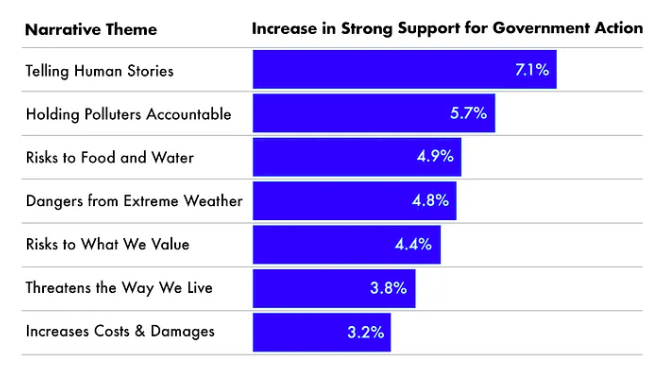
The Most Effective Extreme Weather Narratives
Center the climate impacts on real people when persuading others to support climate policies. This resource found that every single narrative studied drove support for immediate government action on climate change. But one message rose above the rest—it was a story: “Bucky Squier was just 17 years old when Camp Fire in California terrorized his hometown in 2018. ‘I have friends who lost their homes in that fire,’ he recounts. ‘My community has pretty much never been the same. I couldn’t even practice cross country for weeks because of the smoke.’ Bucky is just one of many across the country affected by extreme weather. In 2022, 8 in 10 Americans reported being affected by extreme weather. 1 in 4 of those experienced serious health problems. Pollution is what drives climate change, leading to more frequent and severe extreme weather. Fighting pollution is the solution to limiting climate change and extreme weather. We need to support action on pollution to protect ourselves and the lives of our loved ones.” After listening to this narrative, participants were 9% more likely to support government action on climate change (and 7% more likely to strongly support). Other messages included ‘holding polluters accountable,’ ‘risks to food and water,’ dangers from extreme weather,’ ‘risks to what we value,’ ‘threatens the way we live,’ and ‘increases costs and damages.’
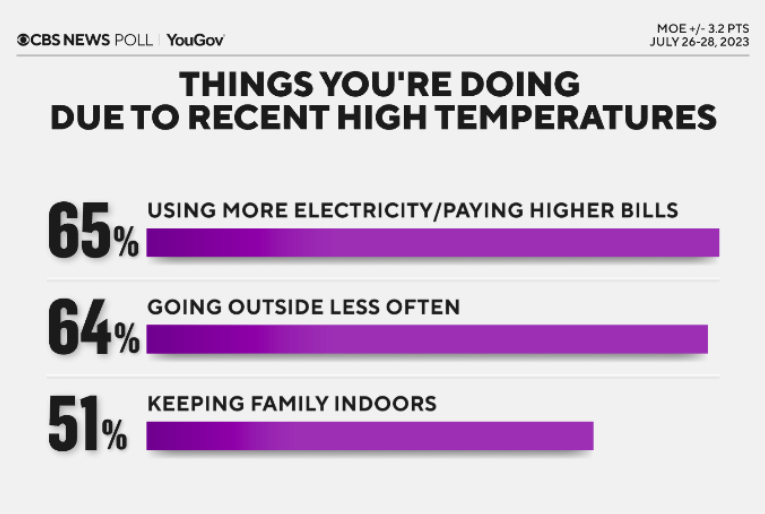
CBS News poll on how people are coping with the heat
Nearly two in three Americans say that their area has been experiencing unusually high temperatures, but Republicans are less likely to acknowledge extreme heat than Democrats. 65% of Americans recognize that their area has experienced unusually high temperatures in recent weeks. Recent high temperatures have made 75% of Democrats but just 28% of Republicans more concerned about climate change and 21% of Democrats but 64% of Republicans report it hasn’t changed their opinion. 50% of Republicans (and 78% of Democrats) do say their area has experienced higher temperatures recently.