Resources
Search below for resources covering the intersection of climate engagement, social science and data analytics.
RESULTS
New Polling Shows Voters Strongly Support SEC Climate Risk Disclosure Rule
Voters support the SEC’s new climate risk disclosure rule and widely agree that people should be able to take climate-related risks into account in their investment decisions. Voters say that large companies and corporations should be held accountable for their environmental impacts: four in five (80%) say that large companies and corporations have a responsibility to manage their impact on the environment, including nearly half (46%) who say that companies have “a lot” of responsibility for managing environmental impacts.

EV Ownership Ticks Up, but Fewer Nonowners Want to Buy One
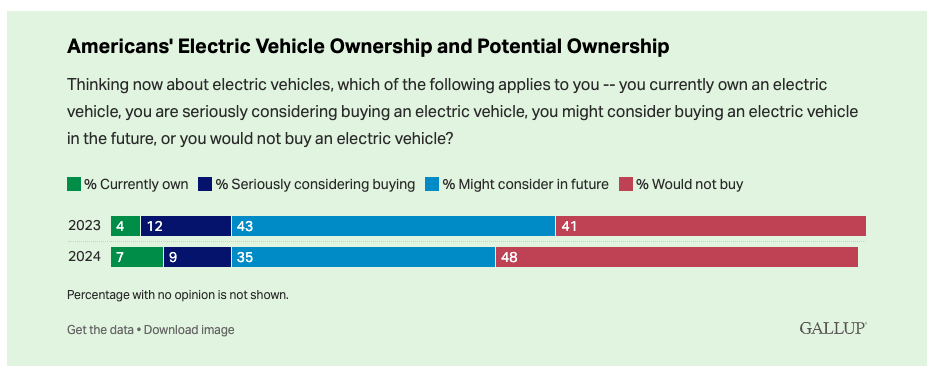
Roughly half of Americans say that they would consider an EV. The percentage of Americans who own EVs has increased in the past year, but so has the share who say that they “would not buy” one. 7% of Americans now report owning an electric vehicle, up three points from last March (4%). The percentage who are “seriously considering” buying an EV has dipped by an equivalent amount, from 12% down to 9%. Taken together, these two shifts suggest that there is a steady share of the population – roughly one-sixth of adults – who either own or are seriously in the market for an EV.
Environmental Polling Roundup - April 5th, 2024
This post includes climate and environment headlines, data points, and key takeaways from recent public polls - including new polling on extreme weather, climate change, and plastic pollution.
HEADLINES
Experiencing Extreme Weather Predicts Support for Policies to Mitigate Effects of Climate Change
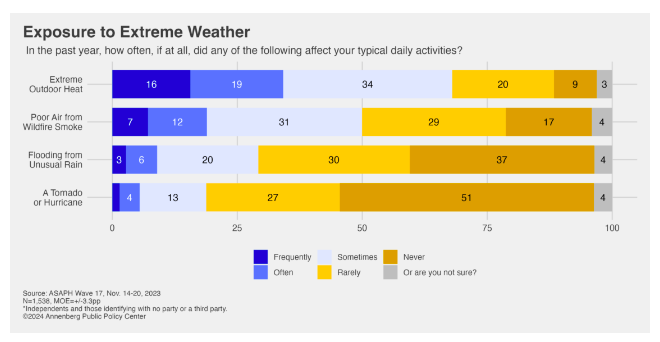
Americans who report experiences with extreme weather are more likely to support pro-climate policies. 62% of Americans support tax credits for families who install rooftop solar or battery storage in their homes. 62% of Americans support increasing investment in energy-efficient forms of public transportation. 60% of Americans support grants to communities to protect them from the impacts of climate change, including drought, heat, and extreme weather. 57% of Americans support forgivable loans for rural communities to improve their energy efficiency.
Pathways to Power Workshop
How are you measuring your organization’s efforts and advances towards meaningful long-term change? Would you like to begin the process of identifying a unique set of metrics that best suit your organizational goals and power-building strategies?
The Federal Funding Primer on Climate Justice
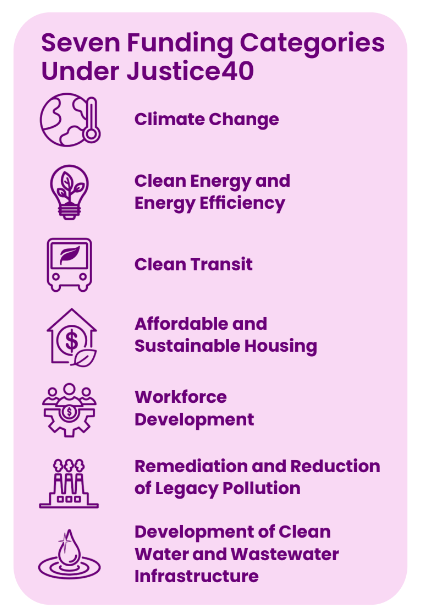
This Federal Funding Primer on Climate Justice provides an invaluable roadmap for navigating the maze of funding opportunities provided by Justice40, the Inflation Reduction Act (IRA), and Bipartisan Infrastructure Law (BIL). The Justice40 Initiative is a requirement of Executive Order 14008 and mandates that 40 percent of the benefits from environmental and climate justice related federal investments go to communities that are disadvantaged, underserved, or overburdened by pollution.
Environmental Polling Roundup - March 29th, 2024
This post includes climate and environment headlines, data points, and key takeaways from recent public polls - including new polling and research on the EPA's vehicle emissions rules, utilities, and people’s emotional responses to climate change.
HEADLINES
Report: US Catholics say environmental justice important, but most unaware of Laudato Si'
Most Catholics in the U.S. believe environmental justice is an important issue. But only a third of them have heard of Pope Francis' encyclical on the topic, with Mass attendance key to familiarity with church teaching on the care for creation. Most of those interviewed (74%) prioritized church teaching on marriage over the environment (66%), followed by immigration (56%), abortion (53%), the death penalty (52%), birth control (48%) and euthanasia (47%).

Poll: Voters Strongly Support Banning Utility Junk Fees and Using Ratepayer Funds for Political Activities
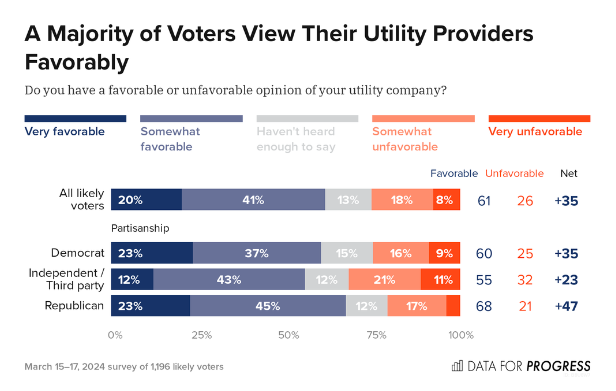
Voters mostly like their utility companies, but overwhelmingly oppose junk fees and utilities using customers’ money to fund lobbying and political activities. 72% of voters support legislation to prevent utility providers from using money collected from customers’ monthly bills to fund political activities. Support for this proposal is very balanced across party lines, with 74% of Democrats, 72% of independents, and 69% of Republicans in favor of legislation that would ban utility companies from using customers’ money on political activities.
A guide to electric car misinformation (part 1)
The closer we get to the 2024 presidential election, the more sketchy information out there about electric cars. GOP polling has shown that attacking electric vehicle (EV) policy has been “amazing” for Republicans. Even the New York Times op-ed section has been fooled by EV arguments. In a recent column, Ross Douthat complained that Biden’s new EPA regulations tell American consumers: “If you like your [gas-powered] car, I don’t want you to keep it.” This is, at best, highly misleading.