Resources
Search below for resources covering the intersection of climate engagement, social science and data analytics.
RESULTS
Poll: Most Americans Are Not Completely Sold on Electric Vehicles
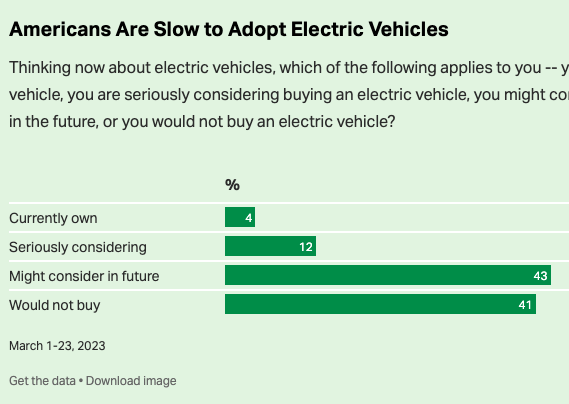
Most Americans would consider purchasing an electric vehicle, though there are large differences in interest by partisanship. Americans’ adoption of electric vehicles is proving to be slow, as relatively few currently own one (4%) or are seriously considering purchasing one (12%). Another 43% of U.S. adults say they might consider buying an electric vehicle in the future, while 41% unequivocally say they would not. While about four in 10 U.S. adults think using EVs helps address climate change “a great deal” (12%) or “a fair amount” (27%), roughly six in 10 believe it helps “only a little” (35%) or “not at all” (26%). Current ownership of electric vehicles among partisans is 6% for Democrats, 4% for independents and 1% for Republicans. Democrats (22%) are also far more likely than both Republicans (1%) and independents (12%) to say they are seriously considering purchasing an EV. The majority of Democrats, 54%, say they may consider it in the future. Meanwhile, a substantial majority of Republicans, 71%, say they would not consider owning an electric vehicle.
This report examines the availability of EVs being sold at car dealerships and the barriers to consumers who are in the market for an EV. Key findings include:

Survey Shows Pathway To Speeding Up EV Adoption in Rural Areas
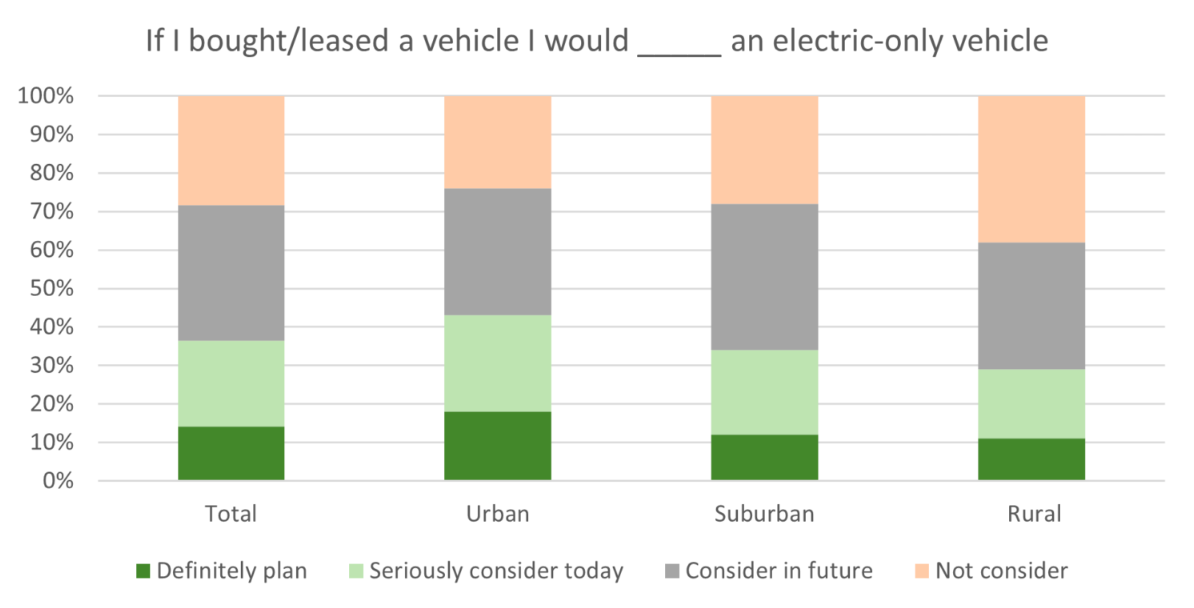
There is plenty of interest in electric vehicles (EVs) in rural areas, but there is a huge knowledge gap about what it is like to own an EV. In a nationally representative 2020 survey, across urban, suburban and rural areas, 4% of the respondents with valid driver’s licenses said they would definitely plan to get an EV for their next vehicle. In the latest survey, which was fielded in early 2022, this share has increased from 4% overall to 11% in rural areas and 18% in urban areas. An additional 18% of rural dwellers and 25% of urban dwellers would seriously consider buying or leasing an EV if they were to get a vehicle today. When considering respondents who would definitely plan and seriously consider (not including those who are open to getting one in the future), this adds up to 29% of rural drivers who would at least seriously consider buying or leasing an EV. Among rural dwellers, only 6% said they were very familiar with the fundamentals of buying and owning an EV, while 30% said they were somewhat familiar. One of the reasons for this lack of familiarity could be the scarcity of EVs in rural areas: only 27% of rural dwellers have seen an EV in their neighborhood in the past month compared to more than half of urban dwellers, and even fewer have a friend, relative or co-worker who owns an EV. A whopping 90% of rural dwellers have never been a passenger in an EV, and almost nobody has ever driven one.
Environmental Polling Roundup - March 10th, 2023
This post includes climate and environment headlines, data points, and key takeaways from recent public polls - including polling about people’s willingness to talk about climate change, new polling on the East Palestine disaster, and a new industry-funded poll in New York State about the state’s Climate Act and residential gas.
U.S. Electric Vehicle Manufacturing Investments and Jobs
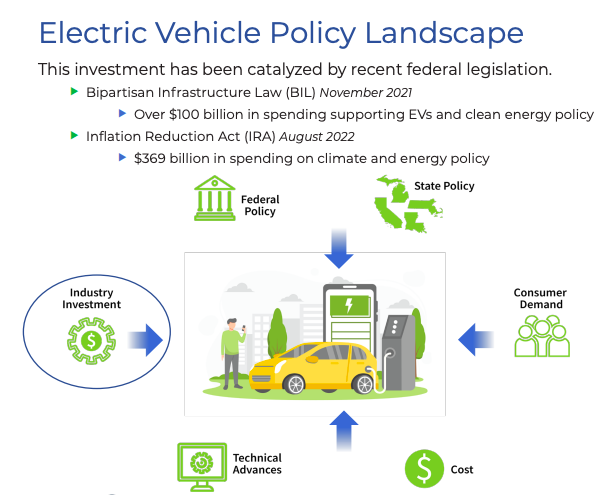
After 6 months since the Inflation Reduction Act’s (IRA) passage, 46,400 new jobs in electric vehicle (EV) production have been announced. This is in addition to the 48,000 new jobs announced between passage of the Bipartisan Infrastructure Law (BIL) (November 2021) and the Inflation Reduction Act (August 2022). From 2015 through November 2021, just 48,600 jobs had been announced. Therefore, two-thirds of all EV jobs announced since 2015 have come since passage of BIL and IRA. State leaders in total EV jobs announced include Georgia (19,400), Tennessee (18, 300), and Michigan (16,300). EV manufacturing capacity has increased 10x from 2021 to 2022 and is projected to increase 8x more from 2022 to 2026. Battery manufacturing capacity in the U.S. is also projected to skyrocket.
EV Jobs Hub
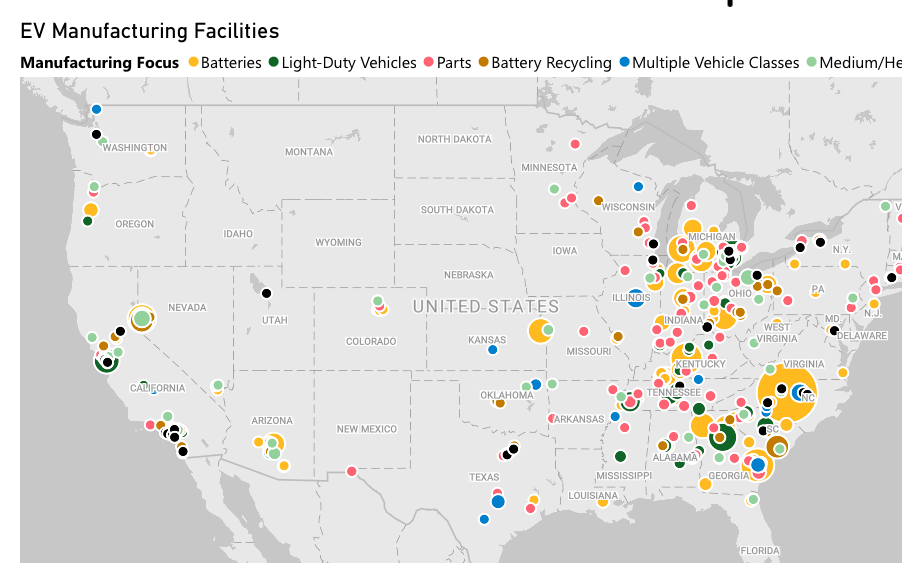
The EV Jobs Hub (EVJH) illuminates not only where new electric vehicle (EV) manufacturing jobs are being announced, but also what those jobs will look like. The EVJH can help labor and environmental advocates hold manufacturers and policymakers accountable for delivering on their investments and promises for good, union jobs in the domestic EV industry. This hub shows the EV jobs announcements—where they are in the US (via a map) and aspects of them, including: manufacturing focus, disadvantaged communities, state and local subsidy, existing union, and congressional district.
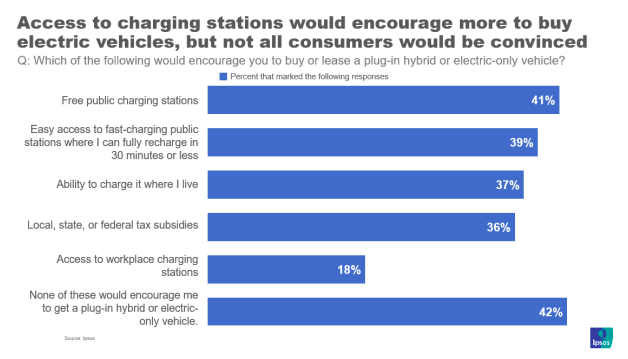
High cost and charging logistics are the biggest concerns holding non-EV owners back from buying or leasing a plug-in hybrid or electric vehicle (EV). Three in five Americans cite high-purchase cost (59%) and difficult logistics (58%) as the reason for not considering an electric vehicle in the next two years. The next tier of worries include maintenance cost (36%) and vehicle performance in very hot or cold weather (33%). Few non-EV owners (18%) have no concerns about purchasing or leasing an electric-only or plug-in hybrid vehicle in the next two years. Two in five non-EV owners would be encouraged to buy or lease an electric vehicle if they had access to free public charging stations (41%) or fast public charging stations (39%). Many would also be nudged to consider these vehicles if they could charge their vehicle at home (37%). Following these charging concerns, government subsidies (36%) and access to workplace charging (18%) may promote EV ownership among those who don’t own these vehicles. Still, 42% of non-EV owners feel that none of the listed incentives would encourage them to consider a plug-in hybrid or electric-only vehicle.
Survey Says: Considerable Interest In Electric Vehicles Across Racial, Ethnic Demographics
Across all racial demographics, overall interest in purchasing EVs is high. Americans of color show at least as great a level of interest in purchasing an electric vehicle as white consumers: 33% of white, 38% of Black, 43% of Latino, and 52% of Asian Americans say they would “definitely” or “seriously consider” purchasing or leasing an EV as their next vehicle. For those individuals who identified charging as an issue limiting adoption, availability of publicly accessible charging remains a greater concern than convenience or long charging times. In terms of perceived cost barriers, more Black and Latino individuals identify maintenance and repair costs as a consideration holding them back from purchasing or leasing an EV (54% of Black and 48% of Hispanic respondents, compared with 37% of white respondents), while more white and Asian Americans for whom cost is an issue identify purchase price as the primary concern. Increasing affordable, accessible, reliable public EV charging infrastructure situated in safe locations would address all of the groups’ biggest concerns about EV charging.
Poll: Mass. residents concerned about climate change, but more worried about health care, education & jobs
Massachusetts residents are concerned about the impacts of climate change, with majorities saying that climate impacts like heat waves, coastal flooding and more powerful storms are already or very likely to hit the state in the next five years. However fewer than half of residents (47%) list climate change as a high priority -- it trails behind worries about health care, jobs and the economy, education, taxes, and fuel costs. The new survey suggests concern over climate change has declined since a similar poll in 2019 in which 54% of residents called climate change a high priority for state government.
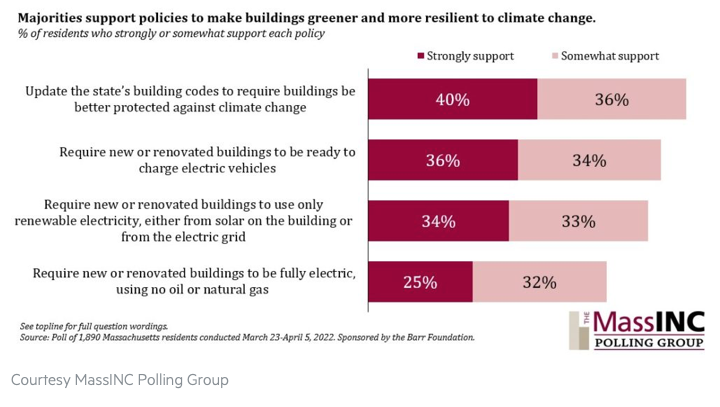
Majorities of MA residents support climate and energy policies including:
- Update the states' building codes to require buildings to be better protected against climate change (76%)
- Require new or renvoated buildings to be ready to charge electric vehicles (70%)
- Require new or renovated buildings to be fully electric, using no oil or natural gas (57%)
Additional analysis and data visualizations in this article from WBUR.
Poll: Higher gas prices a factor for those considering a hybrid or electric car
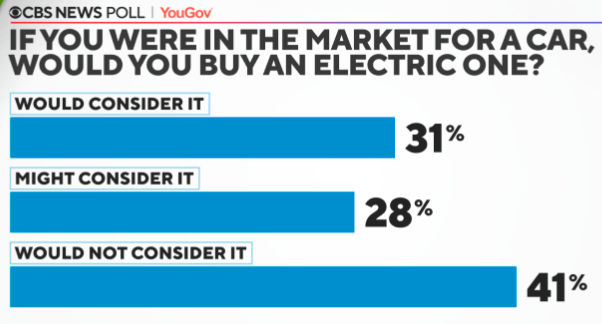
For Americans who would consider purchasing an electric vehicle, high gas prices are now nearly as common of a rationale as environmental reasons. 31% of adults say they would consider purchasing an electric vehicle if they were in the market for a car today, compared to 30% who said they would consider an electric vehicle when asked the same question last April. Notably, when the poll asked interested consumers why they would consider a hybrid or electric vehicle, high gas prices (63%) only narrowly trail environmental cleanliness (66%) as a rationale for those interested in buying hybrids or EVs. These factors were cited far more often than the next most common rationales, including the fact that car companies are shifting to making more hybrids and electric vehicles (44%) and the increase in models and options to choose from now (42%).